
A wood to plastic conversion of the leg component for Diamond Billiard Products reduced labor, improved durability, accelerated tournament installation and positioned Diamond for continued growth.
For decades, professional billiards has been defined by precision. At the highest levels of competition, even the smallest variation in performance matters.
So when Diamond Billiard Products set out to modernize one of the most traditional components of its tournament tables, it wasn’t a cosmetic upgrade. It was a structural and operational transformation.
Diamond’s original table legs were made of wood, durable and traditional, but complex to manufacture. Each leg required cutting, shaping, sanding, finishing and pre-assembly across multiple departments. The process involved eight employees and 10 to 12 individual components per leg. From raw material to finished product, production could take up to three months. Brent Lykins, mechanical engineer at Diamond, explains: “I’m here to find better ways of doing things, approaches to reduce manufacturing time and enhance performance. The wood legs were very labor intensive. We wanted to streamline it.”
Installation was also inefficient. At tournaments, installers had to access leveling nuts near the floor, often lying on their backs to make adjustments. With tables set up across uneven venues, this process was slow and physically demanding.
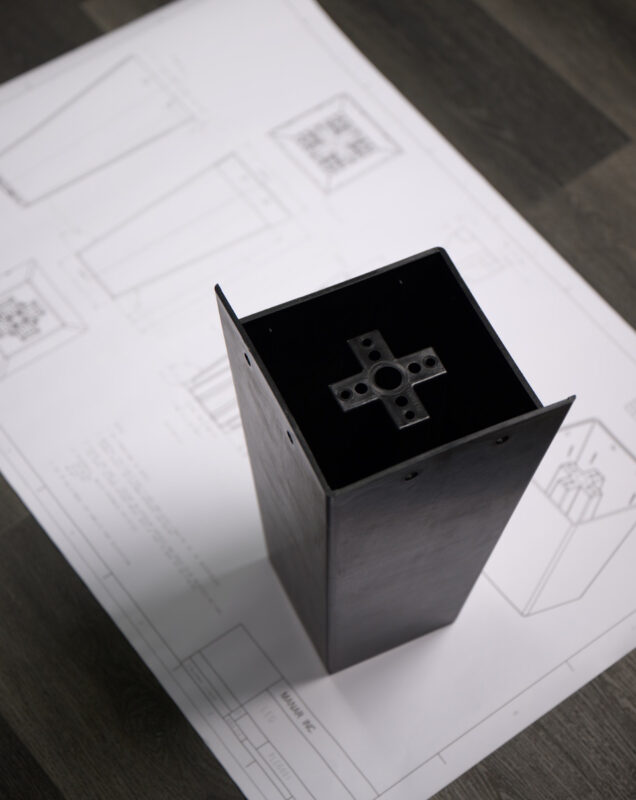
Diamond spent several years developing concepts and 3D-printed prototypes before moving forward. To make the design manufacturable at scale, they partnered with Manar. Together, the teams refined the design for injection molding while ensuring it could meet tournament-level demands. The final material, 40% long-glass polypropylene, provided the strength required for structural performance. FEA validation confirmed the legs could support a 1,200- to 1,300-pound table with minimal deflection. Diamond also conducted real-world stress testing, lifting and dropping tables to confirm durability.
The operational impact was dramatic. The wood legs that once required months of multi-step handling were replaced with a molded structural component produced in a fraction of the time. Part consolidation reduced 10 to 12 wood components to a primary molded body with a foot block and shaft.
The new design also improved tournament setup. Instead of accessing adjustment points from underneath, installers now use a side-access panel and battery-powered tool while seated. Legs can be adjusted up to 1.5 inches to accommodate uneven floors. Installation is three to four times faster, with improved ergonomics without sacrificing precision. At large tournaments with hundreds of tables, the time savings are substantial.
Anthony Neeley, new business development and director of operations at Manar, explains, “This wasn’t just about molding a part. It was about applying a design for manufacturability approach to meet the structural demands of tournament-level use and deliver measurable operational improvements. When Diamond needed legs, they needed to know they could count on us, and that’s exactly what we deliver.”
Manar played a critical role early in the process, helping to refine Diamond’s initial concepts into a manufacturable solution. As an extension of Diamond’s engineering team, Manar provided guidance on material selection, part design and tooling while helping validate performance through analysis and real-world testing. The result was a solution that not only met structural demands but could also be produced reliably at scale. Diamond’s facility is located near a Manar location, allowing for close collaboration, rapid sample exchange and hands-on engineering support. Diamond now relies on Manar for leg production and continued innovation.
Following the success of the legs, Diamond partnered with Manar to manufacture its table pockets. Previously, pocket components were molded domestically, shipped to Taiwan for leather wrapping and returned, resulting in long lead times of up to three months, freight delays, quality fallout of up to 50% and risk exposure.
The pocket:
Consolidates parts and eliminates a production step
Removes dependency on overseas finishing
Uses automated molding with robotic insert placement
Offers improved durability and a modern matte black textured finish

Pool tables are iconic, traditional products. Innovation in this category isn’t common. But Diamond saw an opportunity. By converting a core structural component from wood to composite, they:
Reduced labor and manufacturing time
Improved installation ergonomics
Increased durability
Strengthened supply chain reliability
Maintained tournament-level performance
Through its partnership with Manar, Diamond successfully modernized a legacy product without compromising the quality players expect.